What is Four-Field Mapping Process Analysis?
Simply put, Four-Field mapping is a process documentation and analysis method that is a better way to understand, improve and transform business processes
Most organisations have process documentation somewhere. There are flowcharts, procedure manuals, system guides and spreadsheets explaining how work is supposed to happen.
Yet when improvement projects begin, a familiar problem often emerges: the documented process and the real process are rarely the same thing.
People develop workarounds. Information gets passed through unofficial channels. Delays occur between teams. Systems create extra effort. Frustrations build. And although everyone knows there are problems, it is often difficult to pinpoint exactly where they originate.
This is where Four-Field Mapping (FFM) offers a different approach.
At Gradient Transforming, we use our proprietary Four-Field Mapping methodology to capture not just what a process does, but how it works in practice. By combining visual process mapping with timing analysis, information-flow tracking and operator insight, FFM creates a far richer understanding of business operations and reveals opportunities for meaningful improvement.
What Is Four‑Field Mapping?
Four-Field Mapping is a structured, workshop-based methodology for analysing and improving business processes.
Rooted in Lean thinking and developed from concepts originally introduced by Dan Dimancescu in The Seamless Enterprise and subsequently enhanced through Lean process management research, the approach has evolved into a practical framework for modern business transformation.
Unlike traditional process mapping, which often focuses solely on activities and decision points, Four-Field Mapping investigates four critical dimensions of a process:
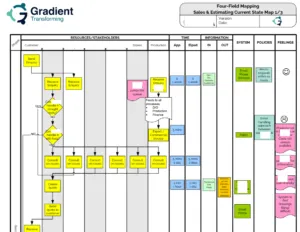 1. Process Activities
What tasks are performed, by whom, and in what sequence?
2. Information and Data Flows
What information is exchanged? Where are the handovers between teams, departments or systems? What data is created, modified or consumed?
3. Timing and Performance
How long do activities take? Where does waiting occur? Which stages create delays or bottlenecks?
4. User Experience and Pain Points
How do the people performing the work feel about the process? What frustrates them? Which activities feel unnecessarily difficult, repetitive or risky?
The result is a comprehensive picture of both the technical and human aspects of a process.
Why Traditional Process Mapping Often Falls Short
Many process mapping exercises produce attractive diagrams that ultimately deliver limited value.
A standard flowchart might tell you:
- The steps in a process
- Decision points
- Roles and responsibilities
What it often fails to show is:
- Where information is repeatedly re-entered
- Which handovers cause delays
- Where teams rely on spreadsheets outside the core systems
- Which activities add little value
- What employees find frustrating or difficult
- Why errors occur repeatedly
Without this additional context, organisations risk documenting problems rather than solving them.
Four-Field Mapping is specifically designed to uncover these hidden issues before they become barriers to transformation, process improvement or system implementation.
The Power of Information Flow Analysis
One of the most valuable aspects of Four-Field Mapping is its focus on information flow.
In most organisations, work does not move through a process on its own – information does.
Quotes become orders. Orders become schedules. Schedules generate deliveries. Deliveries create invoices. Every stage depends on data being passed accurately and efficiently between people and systems.
By explicitly mapping these handovers, we can identify:
- Duplicate data entry
- Manual workarounds
- Missing information
- Delayed approvals
- System integration gaps
- Ownership ambiguities
These are often the root causes of inefficiency, yet they are frequently invisible in conventional process documentation.
Why We Capture Feelings as Well as Facts
Many process analysis methodologies focus entirely on objective measures.
We believe something important gets lost when human experience is ignored.
When operators tell us:
- “This step is a nightmare”
- “We have to check this three times”
- “Nobody trusts the system”
- “This always causes problems”
they are often highlighting genuine operational risks.
In Four-Field Mapping workshops, we actively capture these perceptions and frustrations. We refer to them as process pain points.
Interestingly, the areas people dislike most are often where we find:
- Excessive complexity
- Poor system design
- Rework loops
- Unclear responsibilities
- High error rates
- Hidden operational costs
By documenting how people feel about a process alongside the technical workflow, we uncover insights that purely analytical approaches frequently miss.
How Four-Field Mapping Works
Our methodology typically operates across three connected stages.
Stage 1: Big-Picture Mapping
We begin by developing a high-level view of the process landscape.
This helps identify:
- Process boundaries
- Major process phases
- Stakeholders
- Dependencies
- Areas for deeper analysis
Before analysing the details, everyone gains a shared understanding of how the organisation operates as a whole.
Stage 2: Detailed Four-Field Mapping
This is where the real insight emerges.
Facilitated workshops bring together process owners, subject matter experts and operational teams to map processes in detail, capturing:
- Activities
- Decision points
- Timings
- Systems used
- Information flows
- Handovers
- Pain points
- Improvement opportunities
Because the mapping is completed collaboratively, the output reflects reality rather than assumptions.
Stage 3: Impact vs Effort Assessment
Once opportunities have been identified, we evaluate them according to potential business benefit and implementation effort.
This allows organisations to:
- Prioritise improvements
- Build realistic roadmaps
- Focus investment where it can create the greatest value
More Than Process Documentation
While Four-Field Mapping produces clear and consistent process documentation, that is only part of the value.
The workshops also help:
- Build cross-functional understanding
- Align stakeholders around a shared reality
- Challenge long-held assumptions
- Distinguish genuine business requirements from legacy practices
- Create ownership for future improvements
Participants often leave with a far better understanding of how their work affects other parts of the organisation.
The mapping becomes not just a documentation exercise, but a catalyst for change.
Why Organisations Choose Gradient Transforming
At Gradient Transforming, we do not believe in producing process maps that simply sit on a shared drive.
Our Four-Field Mapping methodology is designed to uncover the realities behind organisational performance and provide a practical foundation for transformation.
Whether you are:
- Preparing for an ERP implementation
- Redesigning business processes
- Improving operational efficiency
- Standardising ways of working
- Capturing business requirements
- Planning a wider transformation programme
FFM helps create a genuinely evidence-based understanding of where improvement opportunities exist and which changes will deliver the greatest benefit.
Ready to See How Your Processes Really Work?
Most improvement opportunities are hiding in plain sight.
The challenge is knowing where to look.
Our Four-Field Mapping process analysis workshops combine process expertise, stakeholder engagement and structured analysis to reveal bottlenecks, simplify complexity and create a clear path towards operational excellence.
If you’d like to understand how Four-Field Mapping could support your transformation programme, contact Gradient Transforming to discuss how we can help uncover the insights hidden within your processes.